It’s not just a choice; it’s a data-driven strategy that aligns with the unique needs and goals of the industry.
-Bidya Bhushan Bibhu ( DPM @ Bureau.id)
Data lakes and data warehouses, though conceptually similar, play distinct roles in the data-driven landscape. Professionals designing data solutions navigate these overlapping models to address business challenges effectively. Let’s delve into the key differences and similarities between data lakes and data warehouses.
Definitions:
Data Lake:
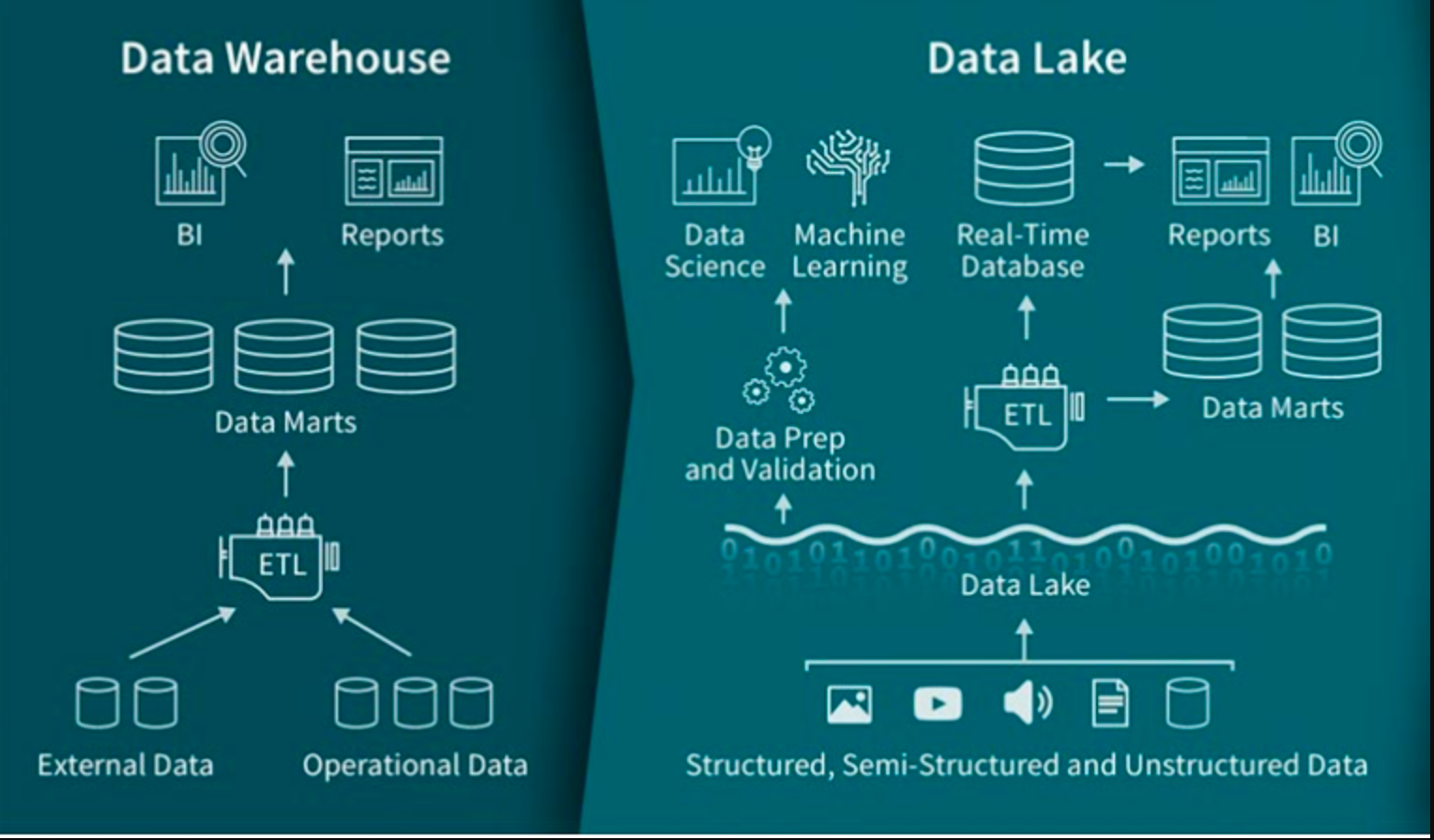
A data lake is a centralized repository designed to store vast amounts of raw data in its native format. It accommodates structured, semi-structured, or unstructured data, providing flexibility for big data and real-time analytics in a fluid, unstructured environment.
Data Warehouse:
A data warehouse is a collection of business data used to aid decision-making. It’s a smaller repository, separating the analytical environment from the transactional one. It focuses on structured data, emphasizing data quality, accuracy, and consistency.
Use Cases:
Data Lake Use Cases:
- Big data & real-time analytics.
- Advanced analytics, including machine learning and predictive analytics.
Data Warehouse Use Cases:
- Business reporting for consistent, reliable insights.
- Decision-making tools like dashboards and visualization software.
Schema:
Data Lake Schema:
- Follows a “schema-on-read” approach, applying structure when accessing data.
Data Warehouse Schema:
- Operates with a “schema-on-write” methodology, transforming and structuring data before storage.
Scope:
Data Lake Scope:
- Can scale up to petabytes, accommodating diverse data types for dynamic enterprise applications.
Data Warehouse Scope:
- Narrower focus, designed for specific structures and operational tasks.
Users:
Data Lake Users:
- Ideal for roles dealing with varied and voluminous datasets, like data scientists and machine-learning enthusiasts.
Data Warehouse Users:
- Suited for business analysts and decision-makers who prioritize standardized data formats.
Data Sources:
Data Lake Sources:
- Includes structured databases, web logs, social media streams, and IoT data.
Processing Data:
Data Lake Processing:
- Adopts the ELT (Extract, Load, Transform) approach, transforming data when queried.
Data Warehouse Processing:
- Utilizes the ETL (Extract, Transform, Load) process, transforming data before storage for immediate analysis.
Design:
Data Lake Design:
- Bottom-up approach, evolving as specific needs arise, providing adaptability to changing data landscapes.
Data Warehouse Design:
- Top-down approach, starting with a predetermined end-goal, ensuring data consistency and alignment with business goals.
Size Comparison:
Data Lake Size:
- Vast reservoir, scales horizontally, suitable for massive unstructured or semi-structured data.
Data Warehouse Size:
- Influenced by server capacity, architectural considerations, and costs, typically smaller but robust.
Cost:
Data Lake Cost:
- Tied to storage volume, data processing, and management, generally more cost-effective on scalable cloud infrastructure.
Data Warehouse Cost:
- Involves upfront costs for infrastructure, licensing fees, and ongoing costs for maintenance and upgrades.
Benefits and Challenges:
Benefits:
- Data Lake: Versatility, economical scalability, complex processing.
- Data Warehouse: Uniform data, quick retrievals, business-aligned.
Challenges:
- Data Lake: Ensuring data quality, robust data governance, potential retrieval latency.
- Data Warehouse: Potential data silos, adapting to evolving needs, high costs.
Choosing Between Data Lake and Data Warehouse:
Preference:
- Data Lake: Varied data streams, flexibility, high-volume, diverse data for cutting-edge analytics and real-time insights.
- Data Warehouse Preference: Consistent, structured data for decision-making, ensuring data uniformity, especially in financial or healthcare sectors.
Cloud Alternatives:
Data Marts:
- Specialized versions of data warehouses tailored to specific departmental data needs.
Data Lakehouses:
- Hybrid solution combining data lake’s storage flexibility with data warehouse’s structured, query-optimized environment.
Databases:
- Traditional databases optimized for managing structured data, may not be suitable for complex analytics or handling vast unstructured data.
Conclusion:
As organizations navigate the evolving data landscape, choosing between data lakes and data warehouses involves understanding each solution’s strengths and constraints. Some may opt for hybrid models, merging the benefits of both systems. Additionally, exploring alternatives like data marts, lakehouses, and traditional databases provides a nuanced approach to evolving data needs.
By grasping the nuances of data lakes and data warehouses, organizations can make informed decisions aligning with their goals and infrastructure requirements.

 Product Data & Everything